Work packages
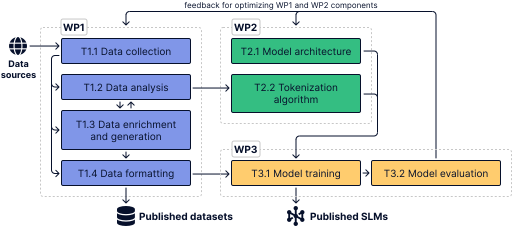
The project runs in three work packages over two years. They are not a relay: WP1 prepares the data, WP2 builds the model and its tokenizer, WP3 trains and evaluates — and what WP3 measures feeds straight back into the data preparation and the architecture, so all three stay open until the end.
WP1 — Data acquisition and preparation
WP1 turns raw text into data a model can learn from. T1.1 Data collection gathers text in European languages, with an emphasis on Slavic ones. T1.2 Data analysis checks its quality and shows which languages and domains are well covered and which are thin; what it finds also guides the tokenizer in T2.2. T1.3 Data enrichment and generation fills those gaps, going back and forth with the analysis until the coverage holds. T1.4 Data formatting shapes the result for pretraining and fine-tuning and hands it to model training in T3.1. The curated datasets are published openly.
WP2 — Model development
WP2 designs the model that data goes into. T2.1 Model architecture assembles the components best suited to information extraction, drawing on both encoder-only and decoder-only designs. T2.2 Tokenization algorithm adapts how text is split into tokens for morphologically rich European languages, informed by the analysis in T1.2. Both feed model training in T3.1.
WP3 — Model training and evaluation
WP3 trains the models and tests them. T3.1 Model training brings together the formatted data from T1.4 and the architecture and tokenizer from WP2. T3.2 Model evaluation measures the trained models against established benchmarks and against both larger models and models of a similar size. Its results feed back into WP1 and WP2, the loop across the top of Figure 1, so the data, the architecture and the tokenizer are refined as results come in. The models that hold up are published openly.
Deliverables
Four reports mark the project's progress, two in each project year. Between reports, notable results appear under News, and every experiment is recorded in the repository as it runs.